
Home Science
Category:

Science

Advertisement

Canada is expanding its investment in quantum technology as researchers and technology companies work to develop computing systems based on the principles of quantum mechanics. On August 28, 2026, the federal government announced a contribution of $195 million to support an $893 million project by Toronto-based Xanadu Quantum Technologies. The initiative is intended to expand the company’s research and development facilities and establish advanced manufacturing capabilities in Canada. According to the government announcement, the project is expected to create 275 jobs while supporting the development and commercialization of quantum technologies.

Quantum computers operate differently from conventional computers by using quantum bits, or qubits, to process information. Unlike ordinary binary bits, which represent one of two possible values, qubits can exhibit quantum properties that allow certain computational problems to be approached in fundamentally different ways. Researchers are studying whether these systems can eventually improve performance in areas such as materials simulation, molecular modelling and selected mathematical calculations. However, quantum computers are not universally faster than classical machines, and many proposed practical applications remain at the experimental stage.

Developing useful quantum computers requires more than creating individual qubits. Researchers must address challenges involving error correction, system stability, manufacturing consistency and the ability to control larger numbers of quantum components. Small disturbances can affect quantum states, making reliable operation technically demanding. Manufacturing facilities capable of producing specialized components are therefore an important part of the broader research effort. Expanding domestic production could give Canadian companies and research institutions greater access to the equipment and technical expertise needed for continued experimentation.
Pages: 1 2

Advertisement

Canada has announced an $80 million investment over four years to expand research into personalized cancer treatment through the Terry Fox Research Institute. The funding, confirmed by Health Canada on September 24, 2026, will support the second phase of the Marathon of Hope Cancer Centres Network. The initiative aims to strengthen cooperation among research institutions and improve the ability of medical teams to study the biological characteristics of individual tumours. Participating institutions and the research institute are expected to match the federal contribution, bringing the combined investment to approximately $160 million.

The research focuses on precision oncology, an approach that uses genetic and molecular information to better understand cancer and identify treatment options. Cancers that appear similar under conventional examination can contain different genetic alterations, and those differences may influence how they develop or respond to particular therapies. By examining the biological characteristics of tumour cells, researchers and clinicians can sometimes identify more targeted treatment strategies. However, precision oncology does not guarantee that a suitable targeted therapy exists for every patient or cancer type.

The latest investment is intended to expand the collection and analysis of clinical genomic information across the participating network. Health Canada reports that the next phase will add approximately 11,000 new cases to the initiative while strengthening systems used to generate, interpret and return genomic results. The program also seeks to include additional cancer institutions, including those serving Canada’s territories. Broader participation could help researchers study more diverse patient populations and investigate differences in disease characteristics across regions.

Pages: 1 2

Advertisement

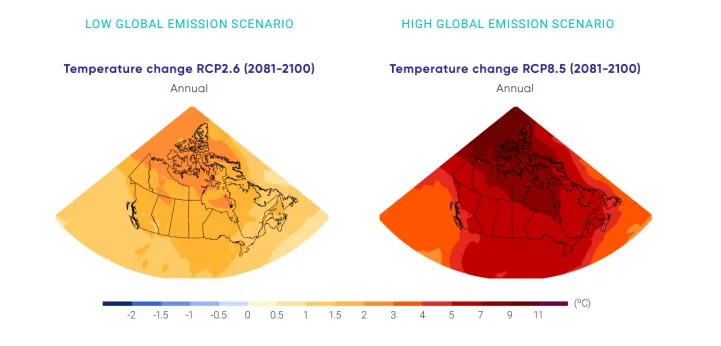
Canada is experiencing substantial long-term changes in temperature, precipitation and seasonal weather patterns, according to a national scientific assessment published in September 2026. Canada’s Changing Climate Report 2026 brings together evidence from observations and peer-reviewed scientific research to examine how the country’s climate has evolved and what changes may occur in the future. The report was developed with contributions from more than 100 Canadian experts working in government and academic institutions, providing an updated scientific foundation for understanding environmental conditions across the country.

The assessment finds that Canada has warmed by approximately 2.0 degrees Celsius over the period examined, while northern Canada has experienced an increase of about 2.6 degrees. Since 1970, the country has warmed at nearly twice the global average rate, with the Canadian Arctic warming approximately three times as quickly as the global average. These differences are significant because northern environments are especially sensitive to changes in snow cover, sea ice and frozen ground. Rising temperatures can alter ecosystems, affect infrastructure and create new challenges for communities that depend on predictable seasonal conditions.

Scientists also identified changes extending well beyond average temperatures. Across Canada, annual precipitation has increased over the past 75 years, with particularly substantial percentage increases in northern regions. The report describes a broader pattern involving more extreme heat, fewer episodes of extreme cold, longer wildfire seasons, changes in river flow and declining snow and ice cover. Glaciers are thinning, permafrost is thawing and surrounding oceans are warming. Although the magnitude of these changes varies by region, the combined evidence indicates that the effects of climate change are geographically widespread.

Pages: 1 2

Advertisement

Canadian astronaut Joshua Kutryk has arrived at the International Space Station following the launch of NASA’s SpaceX Crew-13 mission on October 1, 2026. The spacecraft departed Florida aboard a Falcon 9 rocket, carrying Kutryk alongside NASA astronauts Jessica Watkins and Luke Delaney and Roscosmos cosmonaut Sergey Teteryatnikov. According to the Canadian Space Agency, the Dragon spacecraft docked with the station at approximately 7:05 p.m. Eastern Time, beginning a long-duration mission expected to last around six months.

The flight represents a significant milestone for Canadian participation in human spaceflight. Kutryk is the first Canadian Space Agency astronaut to travel to orbit through NASA’s Commercial Crew Program, which uses commercially developed spacecraft to transport crews to and from the station. His mission is also the fourth long-duration assignment undertaken by a Canadian Space Agency astronaut. Such missions provide opportunities for Canadian researchers to participate in experiments that require extended exposure to the conditions of space.

One of the principal scientific objectives is to improve understanding of human health during prolonged periods in microgravity. The absence of normal gravitational loading affects the body in several ways, including changes to muscles, bones and physiological systems. Researchers use the International Space Station to investigate these responses and evaluate technologies intended to support astronaut health. Observations collected in orbit may also contribute to medical research on Earth, although the application of individual findings requires additional scientific assessment.

Pages: 1 2

Advertisement

Canada and Germany have announced plans to support a new approach to artificial intelligence research, focusing on systems designed to be more transparent, reliable and easier to evaluate. During the ALL IN conference in Montréal on September 16, 2026, representatives of the two governments outlined proposed investments in LawZero, an initiative exploring how advanced AI models can be developed with safety considerations incorporated from the beginning. Canada indicated plans to invest CAD 150 million, while Germany announced a proposed contribution of EUR 100 million.

The initiative comes as researchers and technology companies investigate increasingly capable AI systems that can perform complex tasks, generate information and support decisions across different industries. While these developments have created opportunities in medicine, scientific research and business, they have also raised questions about the reliability of automated outputs. Advanced models can produce inaccurate responses, behave unpredictably in unfamiliar situations or make decisions that are difficult for users to interpret. These challenges have encouraged researchers to examine whether safety mechanisms should be integrated into the design of AI systems rather than added only after development.

LawZero’s research direction reflects an effort to reconsider how advanced artificial intelligence is built and evaluated. Instead of measuring progress exclusively through computational performance or task completion, researchers are exploring methods that may improve the ability to understand and verify system behaviour. Such work involves technical challenges, including the evaluation of model accuracy, the interpretation of internal processes and the development of meaningful safety tests. The proposed approach remains a research objective, not evidence that all problems associated with AI reliability have been solved.

Pages: 1 2

Advertisement

About us

logo

Disclaimer

The information published on this website is provided for general informational purposes only. While we strive to ensure accuracy and keep our content up to date, we cannot guarantee that all information is complete or error-free. Opinions expressed in articles belong to their respective authors and do not necessarily reflect the views of the editorial team. Content may be updated or corrected as new information becomes available.